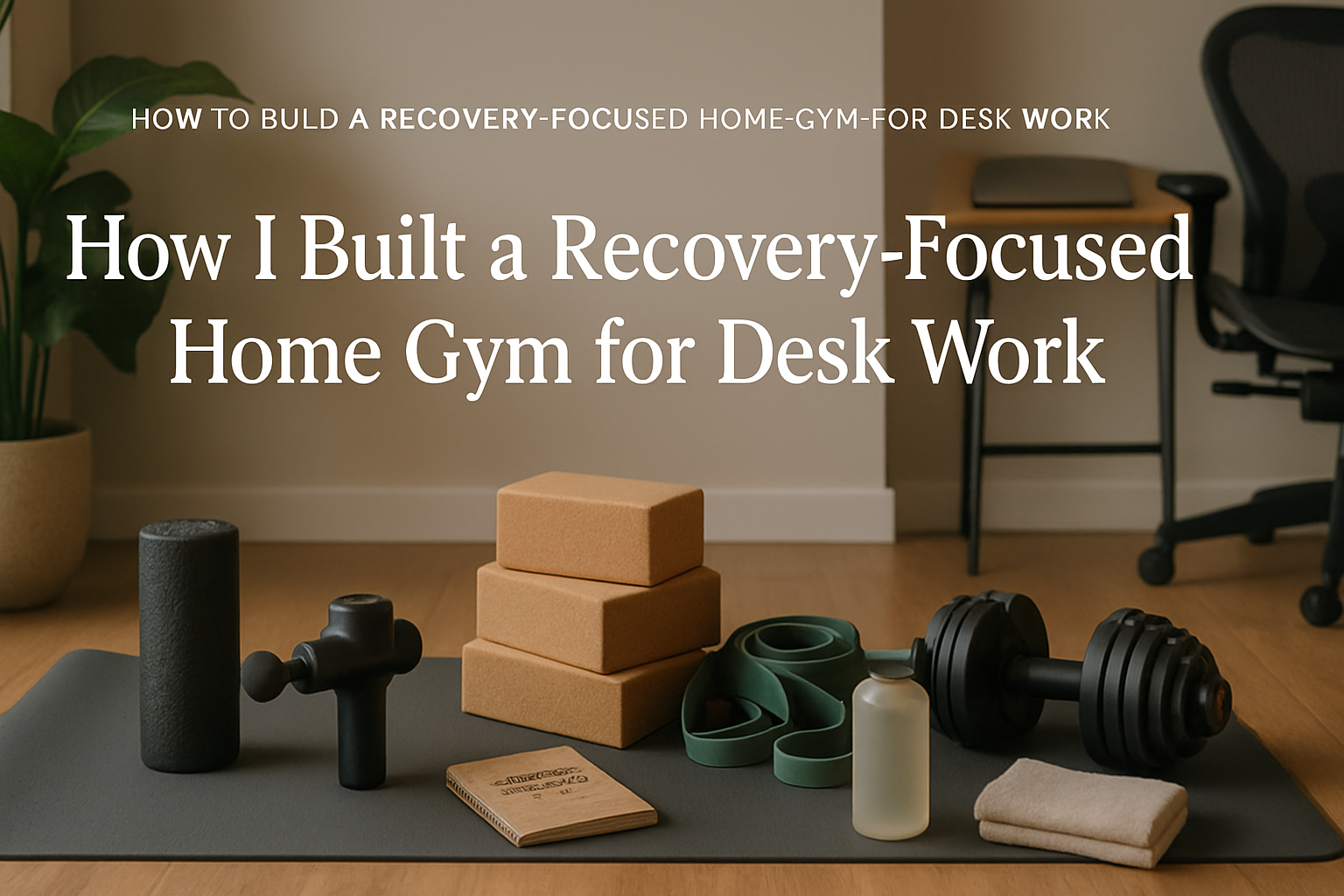
For a long time, I thought my problem was that I “wasn’t working out enough.” That was only half true. The bigger issue was that too many of my days were spent locked into a chair, shoulders creeping toward my ears, hips tightening up, and lower back stiffness showing up by mid-afternoon. I didn’t need a flashy home gym. I needed a recovery-focused home gym for desk workers: something that helped me undo the damage of sitting, move more often, and train without beating myself up further.
Once I looked at it that way, my buying criteria changed. I stopped chasing “fitness equipment” in the generic sense and started focusing on tools that improved mobility, reduced friction, and made daily movement realistic in a New York apartment. That’s the setup I’m using now.
What Was Actually Broken in My Routine
Before pulling out my credit card, I had to get honest about what was failing. I had three recurring problems.
First, I was treating stiffness like a motivation problem when it was really a systems problem. If my shoulders were cooked after laptop time and my hips felt glued together, I was far less likely to do anything intense later. Second, my apartment doesn’t have room for bulky gear that only serves one purpose. And third, I needed equipment that I could use in short bursts between meetings, not just in a perfect 60-minute workout block that almost never happens.
So my home gym became less about maxing out performance and more about recovery, consistency, and joint-friendly movement. For desk workers, that usually means some combination of tissue work, low-impact cardio, floor mobility, and a strength tool that gives you a lot of training value without taking over your living room.
That framework helped me separate what looks impressive online from what actually gets used on a Tuesday at 3:40 PM between calls.
The Recovery Setup I Actually Use
Hyperice X2 Shoulder
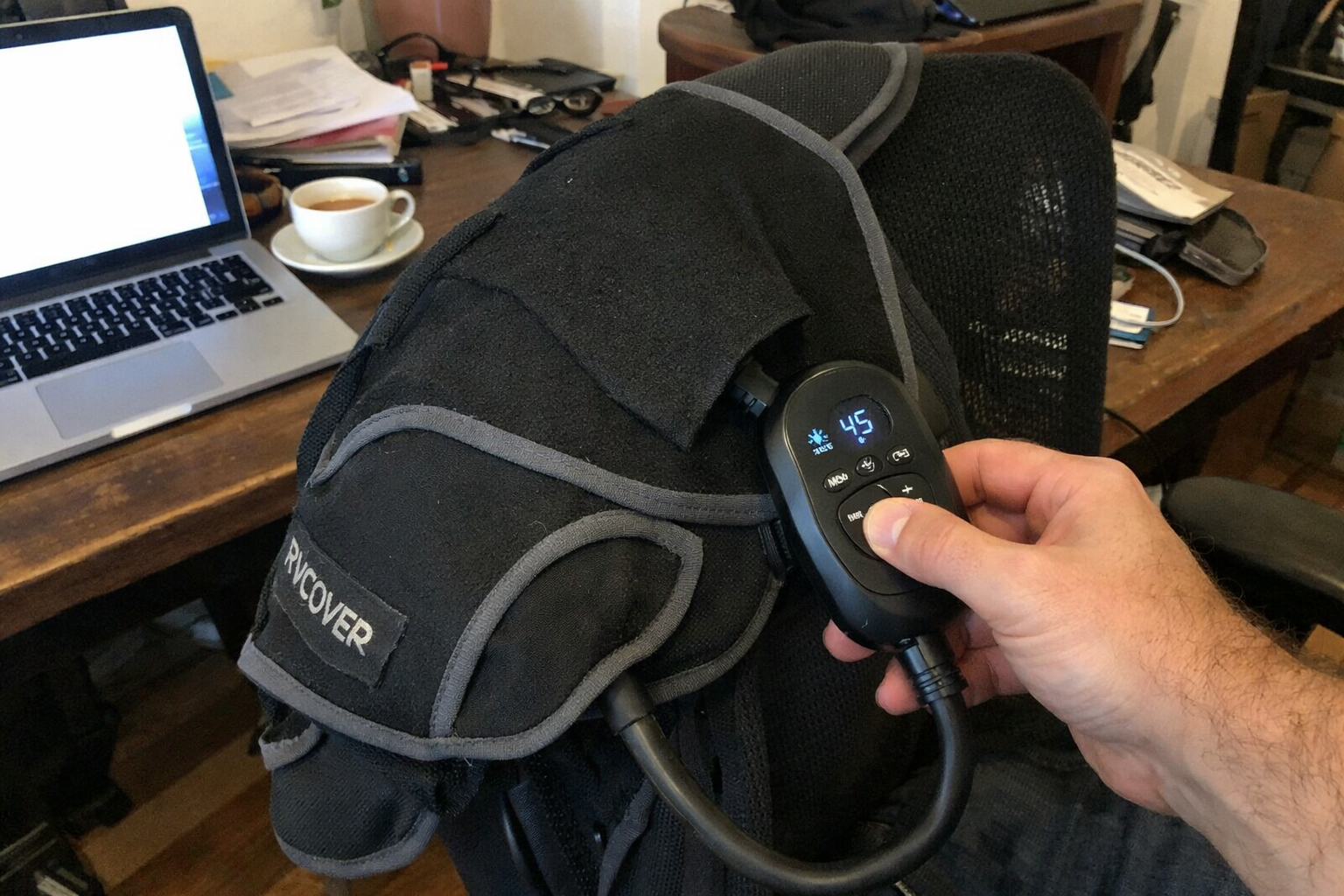
I’m usually skeptical of premium recovery gear because a lot of it is expensive without being meaningfully better. But I eventually added the Hyperice X2 Shoulder after one too many weeks of upper-back tightness spilling into my shoulder. What sold me was the combination of heat, cold, and compression in one unit. For desk workers, the appeal is less about “biohacking” and more about making shoulder care easier to do consistently. I can run a session while reviewing a dashboard or answering email, which matters more than any spec sheet.
It’s definitely a premium piece of kit, and I wouldn’t call it essential for everyone. But if shoulder irritation is the bottleneck that keeps you from training, this kind of targeted recovery tool can make sense in a way cheaper gadgets often don’t.
What I Appreciate
- ✅ Combines heat, cold, and compression in one device
- ✅ Easier to stick with than separate ice packs and heating pads
- ✅ Feels well-built and more durable than most recovery gadgets
- ✅ Useful during work, not just after workouts
What Frustrates Me
- ❌ Expensive for a non-essential category
- ❌ Best value only if shoulder discomfort is a recurring issue
- ❌ Bulkier than simple manual recovery tools
- ❌ Battery-dependent, so charging is one more thing to manage
6-in-1 Foam Roller Set
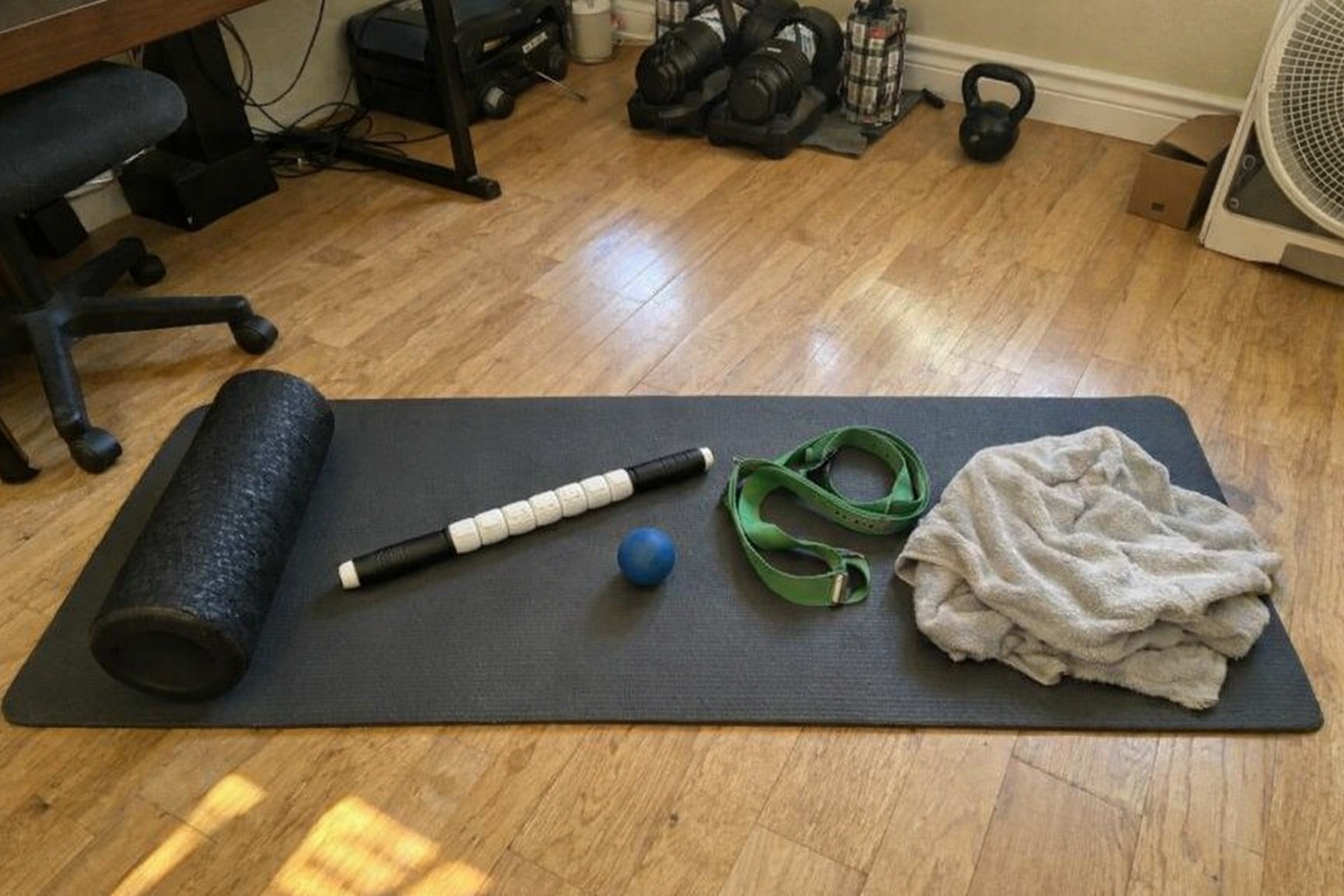
If I had to name the best ROI item in this entire setup, it’s probably the 6-in-1 foam roller set. This is the opposite of glamorous, which is exactly why it works. I use the roller for thoracic spine work and quads, the massage ball for pecs and glutes, and the stick for calves when I’ve been alternating between desk time and cycling. For desk workers building a recovery-focused home gym, this kind of kit covers a huge amount of ground for very little space.
The main thing to understand is that you probably won’t use every piece equally. That’s fine. I reach for a few parts constantly and ignore others for stretches. Even so, having a full set lets me solve specific tight spots without improvising with random household objects, which I’ve absolutely done before.
What I Appreciate
- ✅ Strong value and broad utility
- ✅ Covers back, hips, calves, feet, shoulders, and glutes
- ✅ Easy to stash in a closet or under a bench
- ✅ Great starting point for mobility and tissue work
What Frustrates Me
- ❌ Not every accessory feels equally essential
- ❌ Foam roller sets can look similar, so quality consistency varies by brand
- ❌ Manual recovery still requires effort and routine
- ❌ Can become clutter if you don’t give it a designated storage spot
Adjustable Kettlebell 6.5 to 40 pounds
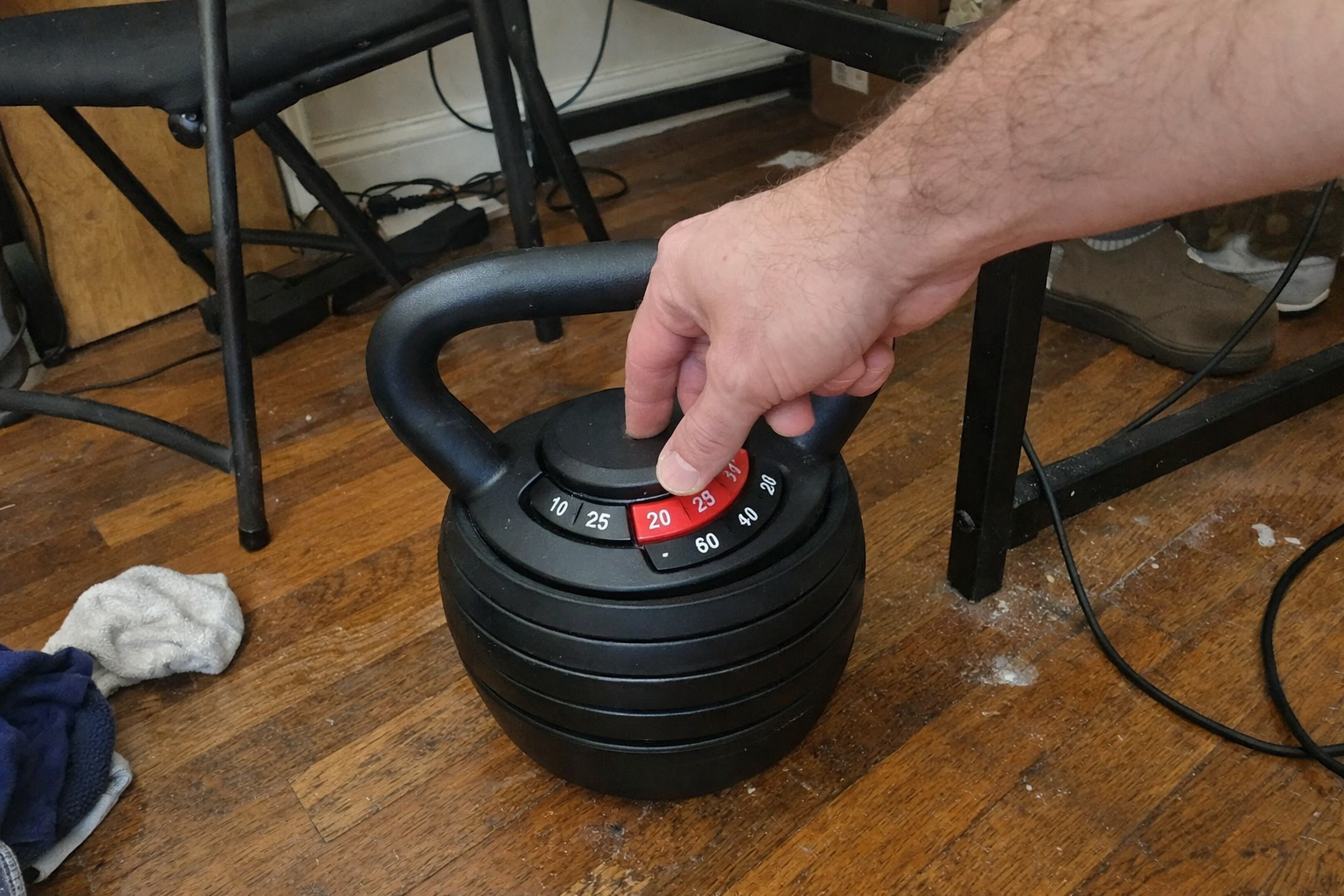
For strength work, I wanted one tool that could support hinge patterns, squats, carries, rows, and presses without eating half my apartment. That’s why I landed on an adjustable kettlebell. In a recovery-focused home gym, strength still matters. In fact, I’d argue it matters more for desk workers because stronger glutes, hamstrings, upper back, and core make sitting all day less punishing.
The adjustable format is the key. Fixed kettlebells feel nicer if you have the room and budget, but most apartment setups don’t. I’d rather have a slightly less elegant tool that gets used than a dream setup that doesn’t fit. Mine lets me move between goblet squats, Romanian deadlifts, swings, and offset marches without owning an entire rack of weights.
What I Appreciate
- ✅ Excellent space efficiency for small apartments
- ✅ Lets me progress without buying multiple kettlebells
- ✅ Useful for both strength and conditioning sessions
- ✅ High training value for lower body and posture-supporting muscles
What Frustrates Me
- ❌ Adjustable designs usually feel less streamlined than fixed bells
- ❌ Weight changes can interrupt flow if you program sloppy circuits
- ❌ Heavier users may outgrow the top end eventually
- ❌ Needs careful handling to preserve the adjustment mechanism over time
Lyrow Thick Foldable Yoga Mat
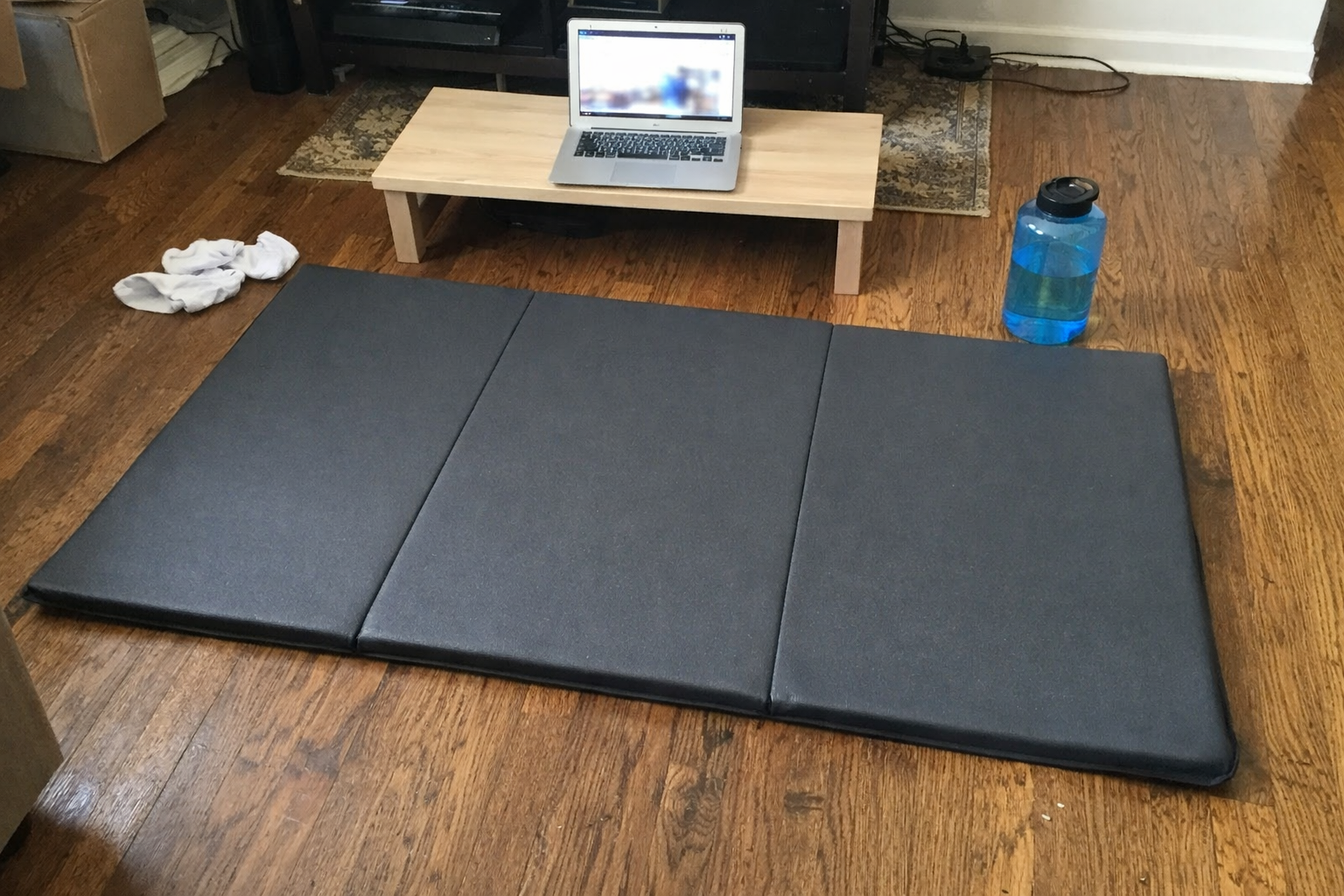
I underestimated how much a comfortable floor surface affects consistency. I eventually switched to the Lyrow thick foldable yoga mat because thin mats made longer mobility sessions annoying, especially for knees, elbows, and anything involving side-lying or spinal work. A thick mat won’t magically improve mobility, but it removes one more excuse to skip it.
This is especially useful if your recovery routine includes breathing drills, hip openers, dead bugs, or floor-based core work. The foldable design also makes more sense in a small apartment than a giant permanent mat that always seems to be in the way.
What I Appreciate
- ✅ Much more forgiving on knees, hips, and elbows
- ✅ Good for stretching, mobility, and bodyweight work
- ✅ Folds away more neatly than some bulky mats
- ✅ Quick to wipe down after use
What Frustrates Me
- ❌ Thicker mats can feel less stable for certain balance movements
- ❌ Takes up more storage volume than a basic yoga mat
- ❌ Not the most elegant option if you want a studio-style look
- ❌ Can still become “background furniture” if left folded in a corner
Walking Pad Treadmill
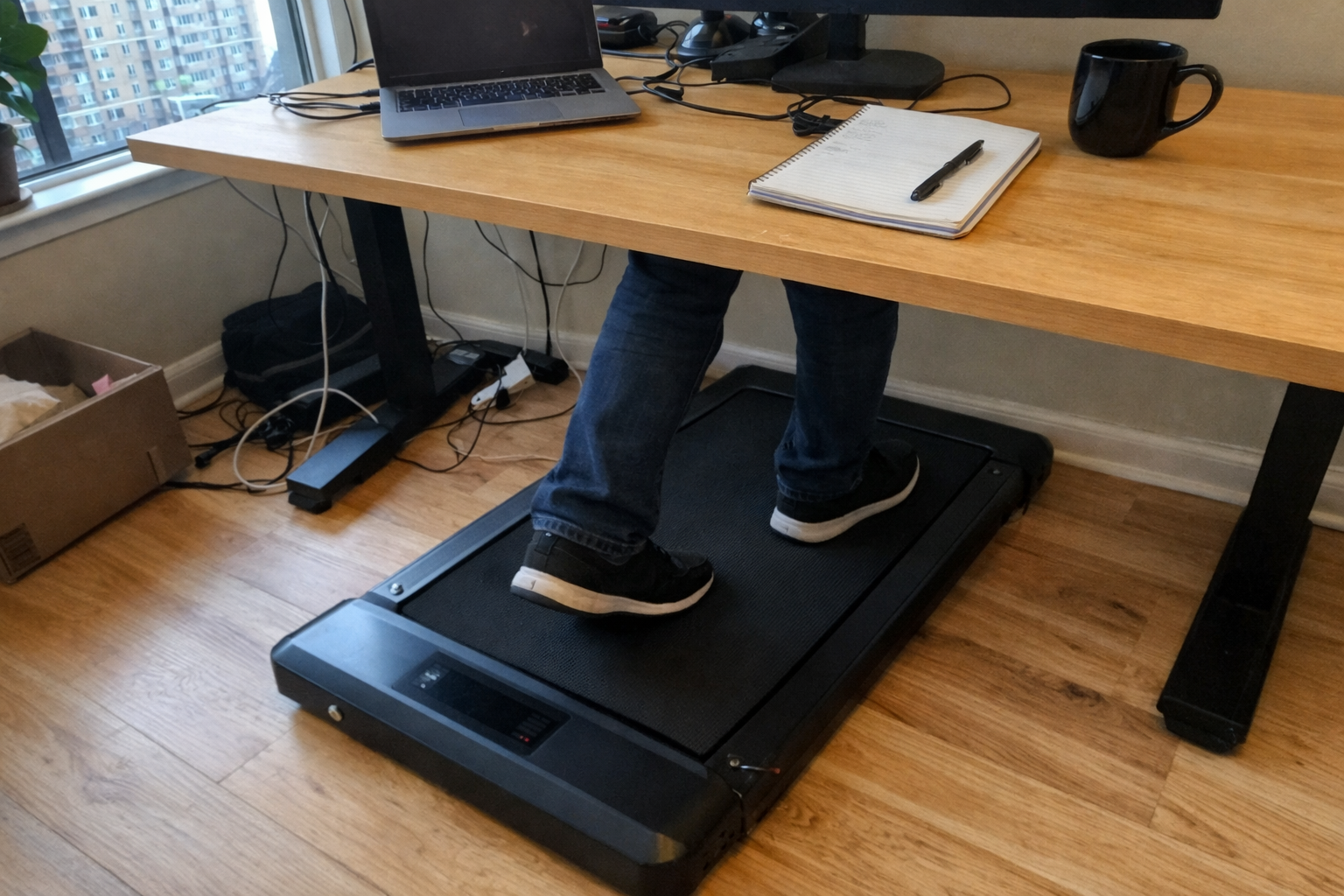
The most practical addition for breaking up sedentary time has been a walking pad treadmill. If you work from home, this is one of the few pieces of equipment that directly attacks the root problem: too many hours of inactivity. I don’t use it for serious run training. I use it for low-intensity walking while catching up on internal calls, listening to stakeholder updates, or clearing inbox clutter that doesn’t require perfect typing speed.
For me, the value is cumulative. A few short walking blocks during the day do more for stiffness and energy than one heroic workout followed by ten sedentary hours. That said, walking pads live or die on practicality. Noise, deck feel, and ease of storage matter more than flashy claims. If it’s annoying to move or too loud for your space, usage drops fast.
What I Appreciate
- ✅ Helps reduce total sitting time in a very direct way
- ✅ Easy to use in short blocks between or during work tasks
- ✅ Slim format works better than full-size cardio equipment in apartments
- ✅ Good complement to strength and mobility work
What Frustrates Me
- ❌ Not a substitute for outdoor walks or real run training
- ❌ Remote-based controls are convenient until you misplace the remote
- ❌ Smaller deck size can feel limiting for longer strides
- ❌ Some floor vibration is inevitable in apartment living
What Each Piece Solves
| Tool | Main Job | Best For | My ROI Take |
|---|---|---|---|
| Hyperice X2 Shoulder | Targeted shoulder recovery | Desk workers with recurring shoulder irritation | High if shoulder pain is your bottleneck, low if it isn’t |
| 6-in-1 Foam Roller Set | Daily mobility and tissue work | Tight hips, calves, upper back, feet | Best value in the whole setup |
| Adjustable Kettlebell | Compact full-body strength work | Glutes, hamstrings, core, upper back | Excellent for small-space training |
| Thick Foldable Yoga Mat | Comfort for floor-based recovery | Stretching, breathing drills, core work | Quietly improves consistency |
| Walking Pad Treadmill | Reduce sedentary time | Work-from-home walking blocks | Strong practical value if you’ll actually use it during work |
What I’m Still Tweaking
This setup is good, but it’s not “done.” The next thing I’m working on is better recovery flow, not more equipment. Right now, the sweet spot for me is ten minutes of tissue work, a short walk, and two or three kettlebell movements rather than trying to cram everything into one long session. I’m also paying more attention to shoulder and thoracic mobility because that’s still where desk time hits me hardest.
If you’re building a home gym for desk workers, that’s probably the mindset I’d recommend most: start with the bottleneck. If sitting all day wrecks your hips, solve that first. If your step count is the problem, solve that first. Recovery-focused training works best when the gear supports the habit instead of becoming another project.
💡 The Final Verdict: Build for Recovery First, Then Fitness
If you sit for a living, a recovery-focused home gym is absolutely worth the time and money—but only if you build it around problems you actually have. For most desk workers, I’d start with a foam roller set, a comfortable mat, and one compact strength tool before adding premium recovery tech. A walking pad makes sense if your workday keeps you planted for hours. The big takeaway is that the best home gym for desk workers isn’t the one with the most gear. It’s the one that helps you move more, hurt less, and stay consistent without taking over your apartment.
Disclaimer: As an Amazon Associate, I earn from qualifying purchases.
Author
-

Hi, I’m Mateo — a remote business analyst and workspace consultant based in New York City.
I started this blog out of a long-term interest in productivity, ergonomics, and the tools that make daily work more efficient. Over the years, I’ve spent a lot of time refining my own setup and comparing different products, from premium office furniture to mechanical keyboards and coffee equipment for the home office. What began as a personal habit turned into a more structured way of reviewing and analyzing workspace gear.
This blog focuses on premium productivity tools and ergonomic equipment, with an emphasis on performance, build quality, durability, and long-term value. I cover products like standing desks, ergonomic chairs, multi-monitor setups, keyboard components, and high-end coffee machines, always with attention to how they hold up in real working conditions.
My approach is straightforward and detail-oriented. I look at products the same way I look at systems: by evaluating trade-offs, comparing alternatives, and asking whether the higher price is actually justified. That means I often compare premium products against strong mid-range options, break down the pros and cons clearly, and focus on return on investment rather than hype.
Outside of work, I’m interested in custom mechanical keyboards, espresso, and indoor cycling — all things that, in different ways, involve precision, consistency, and incremental improvement.
If you’re building a workspace that is comfortable, functional, and designed to last, this blog is for you.
Leave a Reply